SOOID JOURNAL
SkinIngredientsAgeingThe ScienceReviews
Advertising content, published by SOOID. Commissions are earned on purchases made through links on this page.
Home › Skin › What your skincare physically cannot do
Advertisement
6 Things Your Skincare Cannot Do. That Is Why You Still Age.
Your cream stops at about 0.1 mm. Aging happens about 2 mm down, in a layer fed by blood, not by a jar. Your SPF 50 is tested in a lab with a smear you never use, then it wears off, and it never protects you from the inside. That inside leak is the number one driver of wrinkles.
Your skincare cannot reach where aging happens.
Not the expensive jar. Not the clinical serum. Not the SPF you never skip. Legal cosmetics are not allowed into your deeper dermis or your bloodstream. That is what the word cosmetic means. Aging does not care.
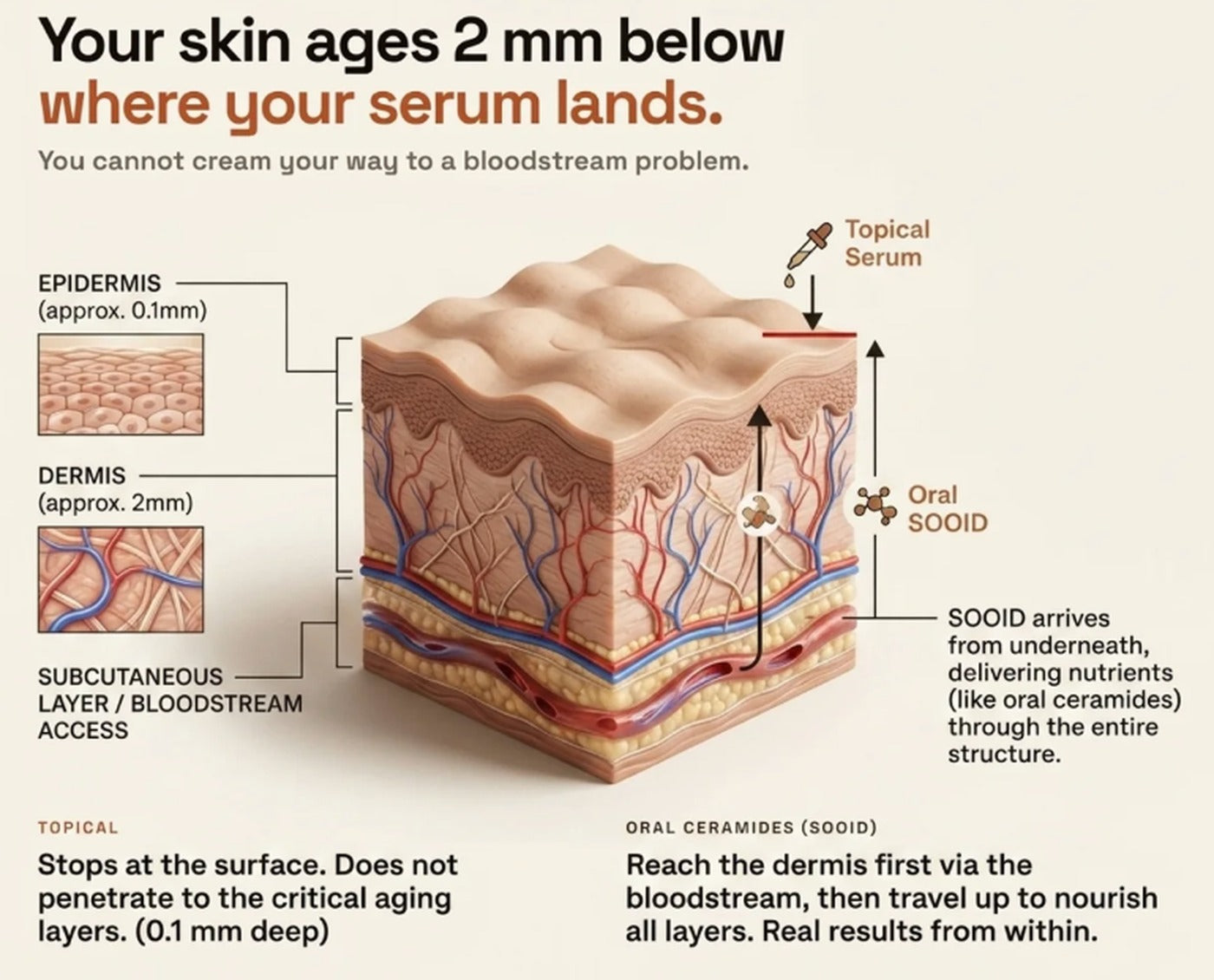
Topical stops at the surface, roughly 0.1 mm in. Oral ceramides reach the dermis first through the blood, then travel up through the whole structure.
Cream sits on the epidermis. Aging starts in the dermis, about two millimetres down. That layer is fed by one thing: your blood. Food can get there. A cream cannot. That is the entire argument on this page.
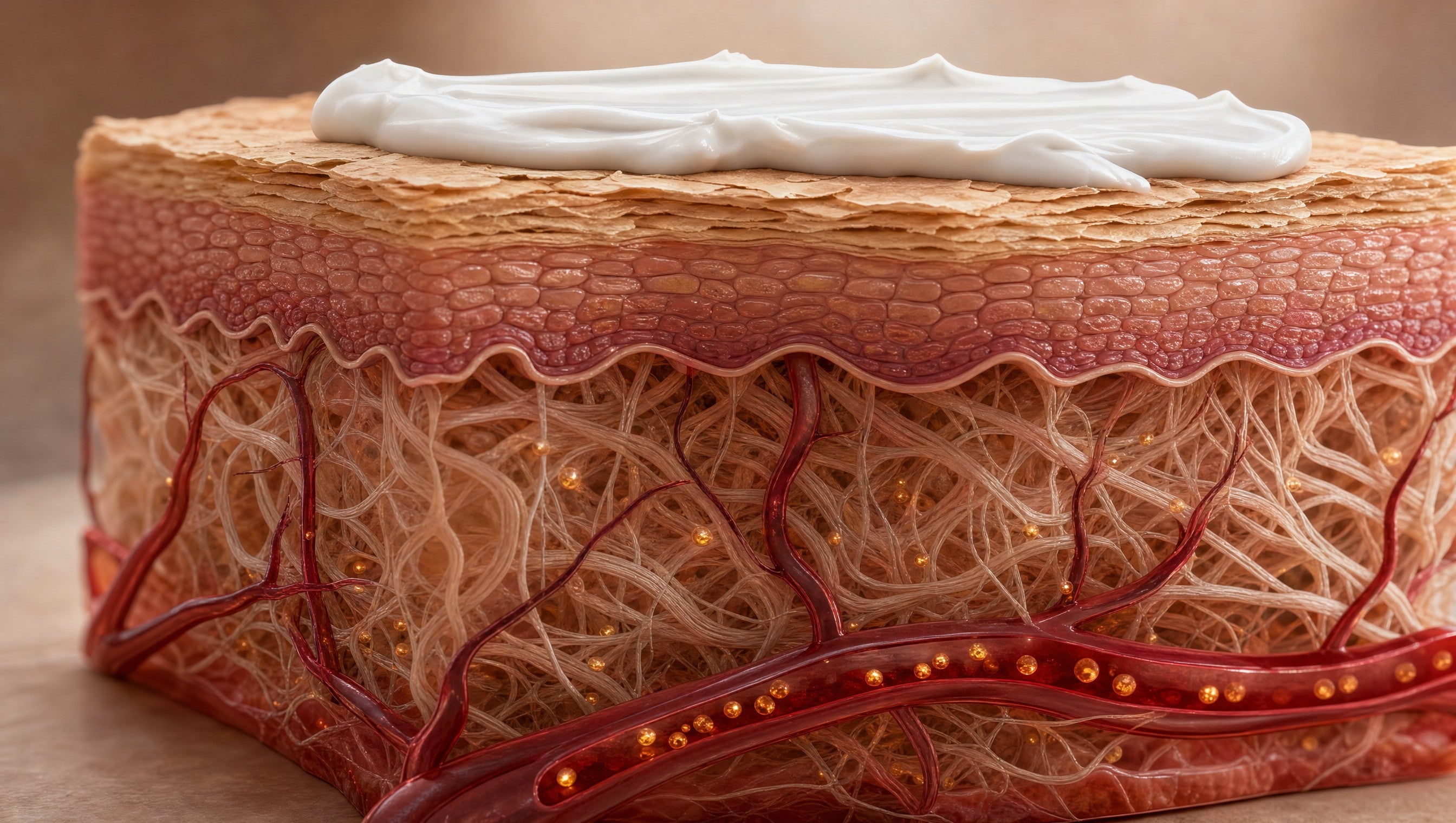
Molecules over about 500 Daltons cannot cross an intact barrier.
The white cream never gets in, and that is the barrier working exactly as designed. The amber particles arrive through the blood vessels in the dermis, from underneath. Only one of those two routes ends where ageing happens.
| What your skincare cannot do | What food / SOOID has | What it does | What was measured |
|---|---|---|---|
| 1. It never reaches the 2 mm Cream stops around 0.1 mm. Aging lives in the dermis, fed by blood. |
Oral route via the bloodstream |
Swallow it. Blood delivers it dermis first, then upward. A cream can only go the other way, and it dies at the door. | Molecules over ~500 Daltons cannot cross an intact barrier. That is physics, not a brand problem. |
| 2. Your SPF number is a lab number You under-apply. It wears off. It never works from the inside. That leak is what wrinkles you. |
Astaxanthin 4 mg · algae / salmon pigment |
Sits inside skin cells and mops up the oxidative hit SPF lets through. Does not wash off, sweat off, or clock out at night. | Haywood 2003: SPF 20+ scored 2 out of 20 against the free-radical damage that ages you. Keep the cream. Stop pretending it is 24/7. |
| 3. Moisturiser cannot rebuild a leaking wall The barrier thins from inside. Cream sits on the leak. |
Ceramosides® 70.65 mg · wheat polar lipids |
You eat the mortar. Blood carries it to the layer a cream cannot enter. | +19% moisture, +18% stretch vs dummy pill. First measurable at day 14. |
| 4. A serum can fade a spot. It cannot stop the next one The factory sits deeper than a brightener stays. |
Lutein + zeaxanthin 10 mg + 2.1 mg · greens, yolk, corn |
Internal light filters. They deposit in skin and soak up the light that makes pigment before a serum can mop it. | Clearer tone. Fine lines got worse on the dummy pill and did not on this. |
| 5. Collagen powder never stops collagen breaking You are feeding a hole. Light and oxidation keep opening it. |
Astaxanthin + Vit A 4 mg + 120 mcg |
Astaxanthin is studied against the oxidative stress that turns on MMP-1, the enzyme that eats collagen. Vitamin A supports renewal from inside, not a smear that peels. | Ito 2018 / pooled elasticity. EU wording for A: contributes to the maintenance of normal skin. |
| 6. Nothing on your shelf works 24/7 Wash your face and the protection is gone. Skin ages in your sleep. |
Six food actives one chocolate, study doses |
Resilience is built the way food builds it: carotenoids and lipids in circulation. Not a film you reapply. | Biotin 450 mcg: contributes to the maintenance of normal hair and skin. The carotenoids are what you notice. |
Six things your skincare cannot do, and the six food-route answers in one jar. Sources: Kern 2024 (n=72, double-blind, placebo-controlled, p<0.001, DOI 10.1111/jocd.16130) · Haywood 2003, J Invest Dermatol 121:862-868, free-radical protection factor in living human skin · British Association of Dermatologists on real-world SPF under-application · Ito 2018 and 2021 pooled analysis (elasticity p=0.009; wrinkle effect not significant) · Juturu 2016, Clin Cosmet Investig Dermatol 9:325-332 (n=46, 12 weeks) · Zastrow 2009, Skin Pharmacol Physiol 22:31-44 · EFSA Reg. 432/2012 for the two claim wordings. Contains milk, wheat, soy, hazelnut, almond and macadamia.
Count the shelf. The SPF you never skip. The vitamin C. The retinol you peeled for. The €80 moisturiser. The drawer of half-used ones. Ten years of that lands most women between €8,000 and €20,000.
Every one of them worked. They did exactly what they were built to do: work on the top tenth of a millimetre.
You do not age in the top tenth of a millimetre. Wrinkles, dark spots, a barrier that leaks by afternoon, collagen that keeps breaking: that is two millimetres down, 24 hours a day, including while you sleep. Your bathroom is off duty the second you wash your face.
Only food builds the resilience that lives in that layer. Salmon and algae carry astaxanthin. Dark greens carry lutein. Egg yolk and corn carry zeaxanthin. Wheat lipids carry the ceramides your wall is actually made of. We put those six actives in one Swiss chocolate, at the doses the trials used. Not a sprinkle.
Skip to what actually reaches it
Or read the six things first.
1
1. Your cream never reaches where aging happens
Cream stops around 0.1 mm. Aging happens around 2 mm down. Only blood reaches that layer.
This is the one the industry cannot say out loud, because if you believed it you would buy fewer jars.
Your cream, your serum, your €80 night cream: they stop in the outer skin. Roughly the top 0.1 mm. That is where your fingertip stops. That is where the molecule size limit lives.
Visible aging does not live there. Firmness. The barrier. The spots that keep coming back. Collagen breaking. That work happens about 2 mm down, in the dermis. The dermis is not fed by a bathroom shelf. It is fed by blood.
You have been treating the paint. The rot is in the wall.
What to do instead is not a better cream. There is no better cream. The door is the wrong door. Deliver actives the way that layer is fed: swallowed, absorbed, arriving dermis first.
Six actives. One chocolate. Through the bloodstream. From within.
2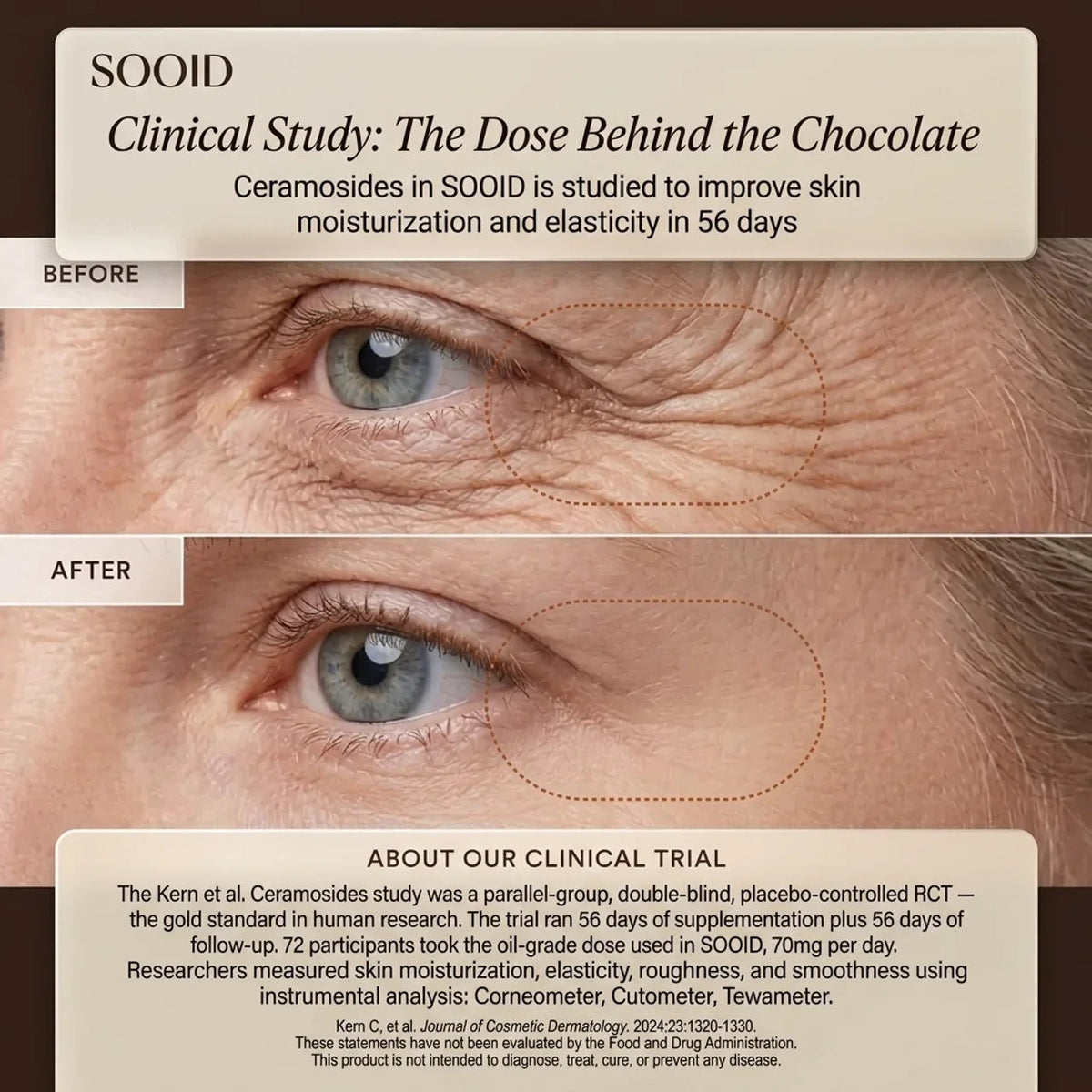
2. Your SPF is not the protection on the bottle. And it never works from the inside.
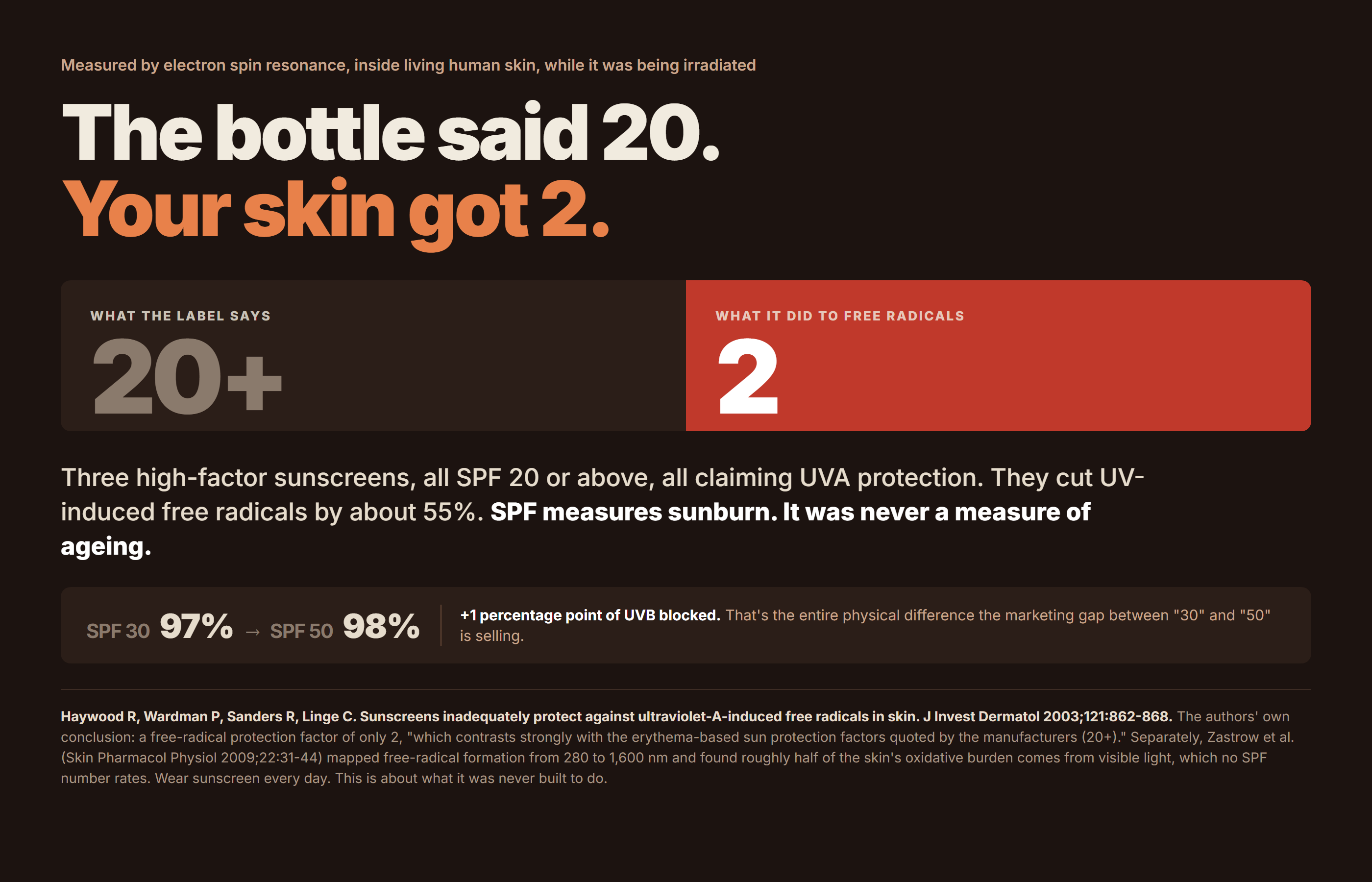
Light that gets past the bottle eats collagen. That is photoaging. The chart below is what the bottle actually scored inside living skin.
Haywood 2003: the label said 20+. Inside the skin, free-radical protection was 2.
This is the number one wrinkle machine on your shelf, and it is the product you trust most.
The number is a lab number. SPF is tested with a thick smear nobody uses in real life. Dermatologists say you get about a third to a half of the protection printed on the bottle. Your SPF 50 is behaving like an SPF 17. That is not a conspiracy. That is how the test is written.
Then it wears off. Sweat. Rubbing. Hours. Lunch. You reapply if you remember. Most days you do not. The label does not follow you into the afternoon.
Then the fatal part: it never protects from the inside. Sunscreen is a bouncer on the door. Once light is in, it starts a chemical reaction that eats collagen. Your cream cannot follow it. Nobody in the bathroom is watching the room.
Somebody measured that. They put strong sunscreen on living human skin and scored the damage inside. Against sunburn it scored 20. Against the free-radical damage that ages you, it scored 2. Haywood, 2003. Not a blog. A journal.
Sunscreen stops you going red. It was never stopping you getting older. That inside leak, 24 hours a day, is danger number one for wrinkles.
Food already solved the inside job. The red pigment in salmon and algae is astaxanthin. One of the strongest antioxidants ever measured in a lab. We put 4 mg a day in the chocolate, the dose used in the skin trials. It sits inside your cells. It does not wash off. It does not clock out at night.
The bodyguard living in the room. On duty 24 hours.
Keep wearing sunscreen. Every day. This is about the job it was never built to do.
3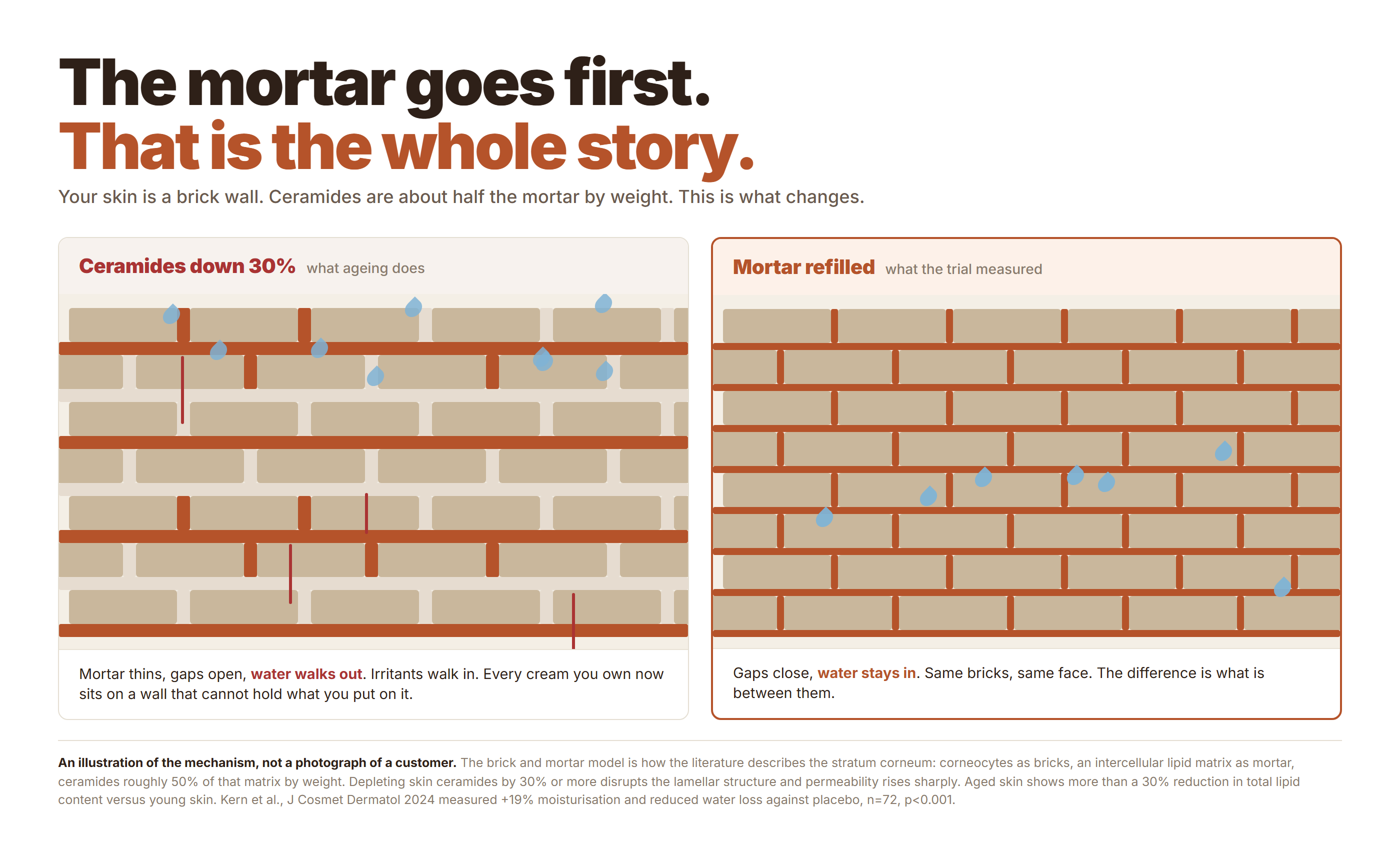
3. Your barrier is breaking from the inside. More cream sits on a leak.
Kern 2024: +19% moisture, +18% stretch vs placebo when the mortar is rebuilt from inside.
After thirty you start losing the mortar that holds the wall together. That mortar is ceramides. Through menopause it falls off a cliff. Water walks out. Everything you put on top now sits on a wall that cannot hold it. That is the tight face by 4pm. That is why the expensive jar stopped delivering.
Then it feeds itself. Gaps let irritants in. Your skin raises an alarm. That alarm tells your skin to make even fewer ceramides. Fewer ceramides, more gaps, more irritants, fewer ceramides again. It gets worse while you do nothing wrong.
So you buy a ceramide cream. Ceramides are too big to get into your skin. They sit on the surface until you wash your face. Most creams use the wrong type anyway. Your wall is built from one kind. The jar uses another.
The food version is wheat polar lipids: Ceramosides®, 70.65 mg a day, the trial dose, not a dusting. You eat it. Blood carries it to the layer the cream could never enter.
In that trial: 19% more moisture and 18% more stretch than the dummy pill, first difference at two weeks. Fix the wall and every serum you own finally has something to sit on.
The mortar of your skin, rebuilt. No cream on earth can do that.
4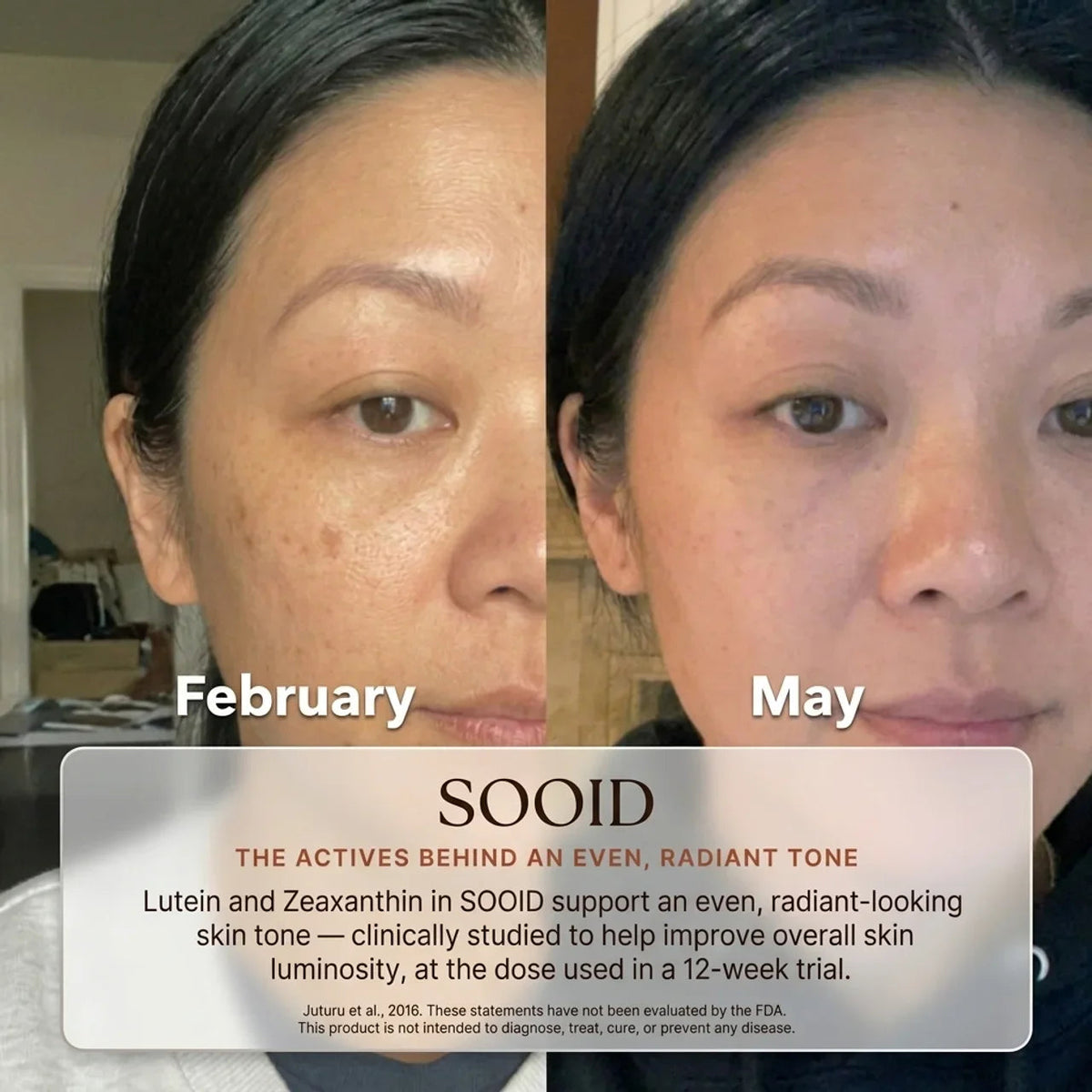
4. Skincare can fade a dark spot. It cannot stop the next one.
This is the spot story. A serum mops what already surfaced. The pair in food is meant to sit in skin before the next one is made.
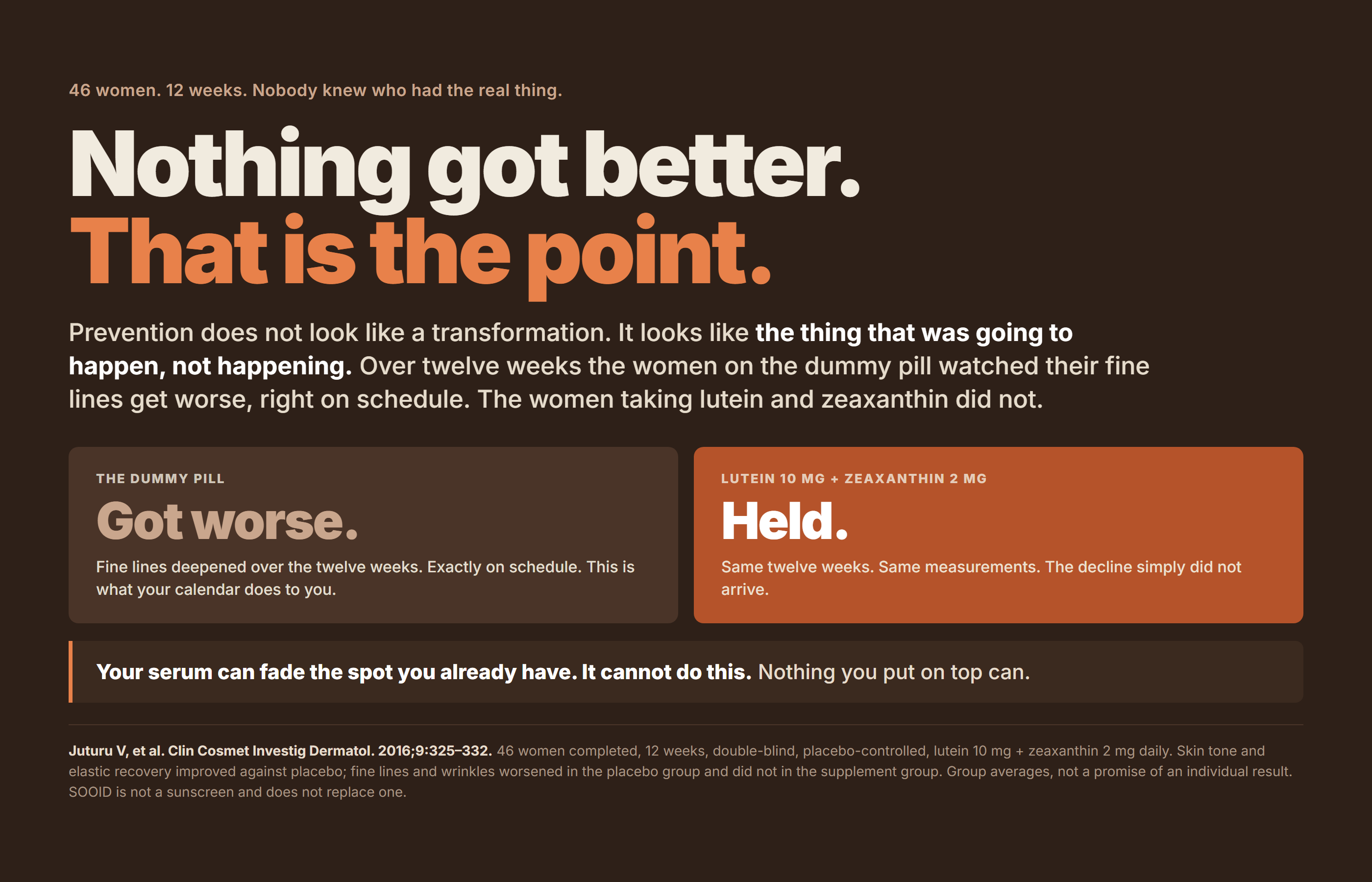
Juturu 2016: 46 women, 12 weeks. Tone clearer. Decline in the dummy group did not arrive in the supplement group.
Every brightening product you own is a mop. It shows up after the damage and works on what already surfaced.
The spot you are fading today was made months ago, deep down, by light that got past your SPF and by the screen you are holding right now. By the time you could see it, the job was finished. Your serum is wiping up a crime that already happened.
And it is happening again today. Because nothing in your routine stands between the light and the cells that make pigment. That is the difference between fading and preventing. One is a mop. One is a roof.
Your phone is part of this. Blue light goes deeper than the UV your SPF is even rated for. SPF only scores one kind of sun ray. Visible light is not it. When scientists split where skin damage actually comes from, about half came from visible light, not the rays everyone worries about. Zastrow, 2009.
The roof is food. Dark leafy greens are full of lutein. Egg yolk and corn carry zeaxanthin. Your body cannot make either. The only way in is to eat them. We put the trial pair in the jar: 10 mg lutein and 2.1 mg zeaxanthin. They deposit in skin and soak up the light before it hits the pigment factory.
Measured, 46 women, twelve weeks: clearer tone. The women on the dummy pill watched their fine lines get worse. The women taking this did not.
The spots you never get are the ones you will never thank us for.
5
5. Collagen never solved why collagen breaks in the first place
You were feeding a hole. Light and MMP-1 keep opening it. This is what that looks like around the eye.
You drank the powder. You ate the gummies. You paid for the peptides. You were feeding a hole.
Collagen is a protein you digest. Your body does not pick it up and slot it into your face. The reason your skin looks older is not that you ran out of collagen powder. It is that light, oxidation and an enzyme called MMP-1 keep breaking the collagen you already have, two millimetres down, where a cream cannot go and a scoop of powder does not stand guard.
That is why the jar never stuck. You were treating the symptom with more of the thing being destroyed.
What food already does: astaxanthin from algae and salmon, circulating, studied against the oxidative stress that turns that enzyme on. Vitamin A from the diet, swallowed, the same family as retinol, without the peel, pressing renewal from inside. We dose both. We do not put collagen in the jar on purpose.
Retinol on the surface still only works up top. It stings. It makes you burn easier. It is off limits in pregnancy. The inside job is a different door.
Stop feeding the hole. Stop the thing that opens it.
6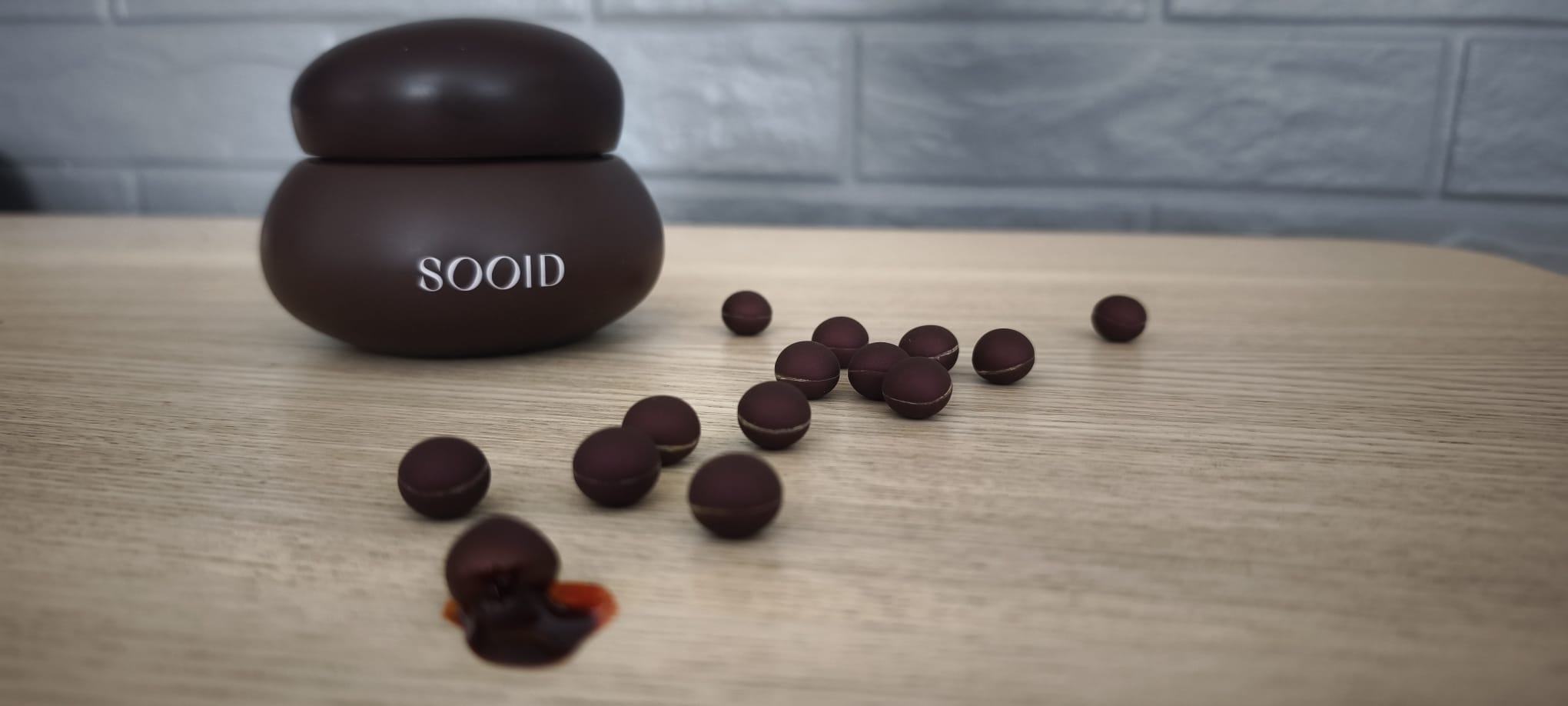
6. Nothing you rub on works 24/7. Only food builds that resilience.
The food actives, in a chocolate, at the trial doses. Protection that does not wash off at the sink.
Wash your face. The film is gone. Sleep eight hours. Your skin is still aging in the dark. A routine is a daytime costume. Aging does not keep office hours.
The only protection that stays is the kind food builds: pigments and lipids that circulate and sit in tissue. Not a smear. Stock.
- Astaxanthin — the red in salmon and algae. Internal antioxidant. Does not wash off.
- Lutein — dark greens. Internal light filter. Your body cannot make it.
- Zeaxanthin — egg yolk, corn. The pair that sits in the membrane and guards both sides.
- Ceramosides® — wheat polar lipids. The mortar of the wall, delivered by blood.
- Vitamin A — the renewal signal, swallowed, not peeled.
- Biotin — the tool keratin needs. Hair, nails, the seal on the barrier. A real dose, not a gummy sprinkle.
That is the system. Freeze new damage. Reverse the leak. Renew from within. One Swiss chocolate, three a day after food. No water. No tray of bottles you quit in week three.
Keep every cream you like. Palombo 2007 already ran the head-to-head: the group who ate the ingredients beat the group who rubbed them on. The group who did both did best.
You have been doing the 20% for a decade. This is the rest of it, on duty while you sleep.
That is the six.
Every one is a job a cream is not allowed to do. Every one has a food-route answer in this jar. You have heard confident supplement claims before. You were right to ignore most of them. So here are the two trials that decide whether any of this is real.
Someone put eating it against rubbing it on. Eating it won.
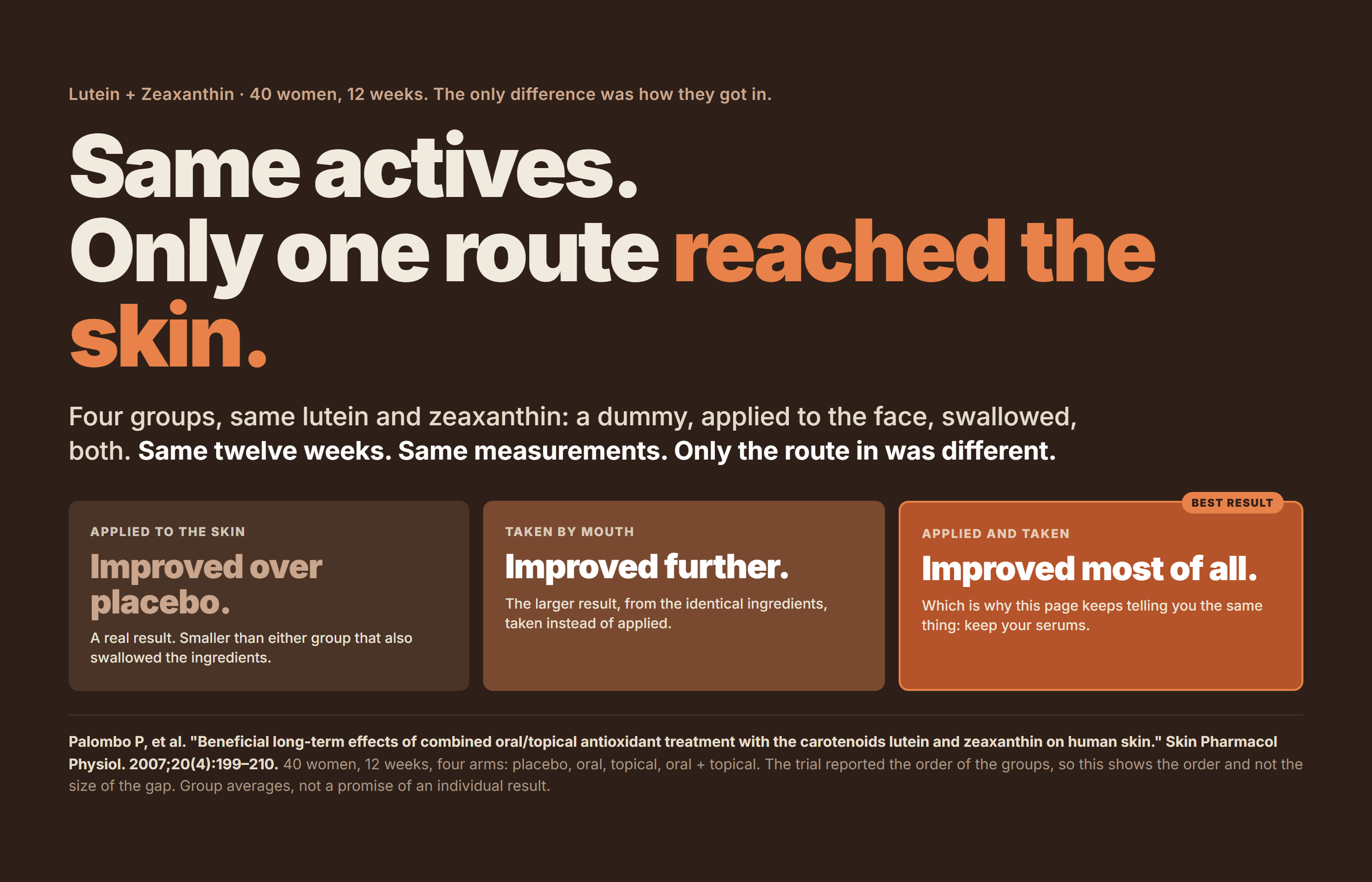
Palombo et al., Skin Pharmacol Physiol 2007;20(4):199-210. 40 women, 12 weeks, four arms: placebo, oral, topical, and both. The trial reported the order of the groups, not the size of the gap, so the graphic shows the order only.
All of the above is theory until somebody tests it. In 2007 somebody did.
Forty women, twelve weeks, four groups. One got a dummy. One ate the ingredients. One rubbed them on. One did both. Same ingredients, same twelve weeks, same measurements, and the only difference was how it got in.
The group who ate it did better than the group who rubbed it on.
The group who did both did best of all, which is the whole point of this page. Do not throw your serums away. Just stop asking them to do the half they cannot reach.
Everything else stops working the day you stop using it. This did not.
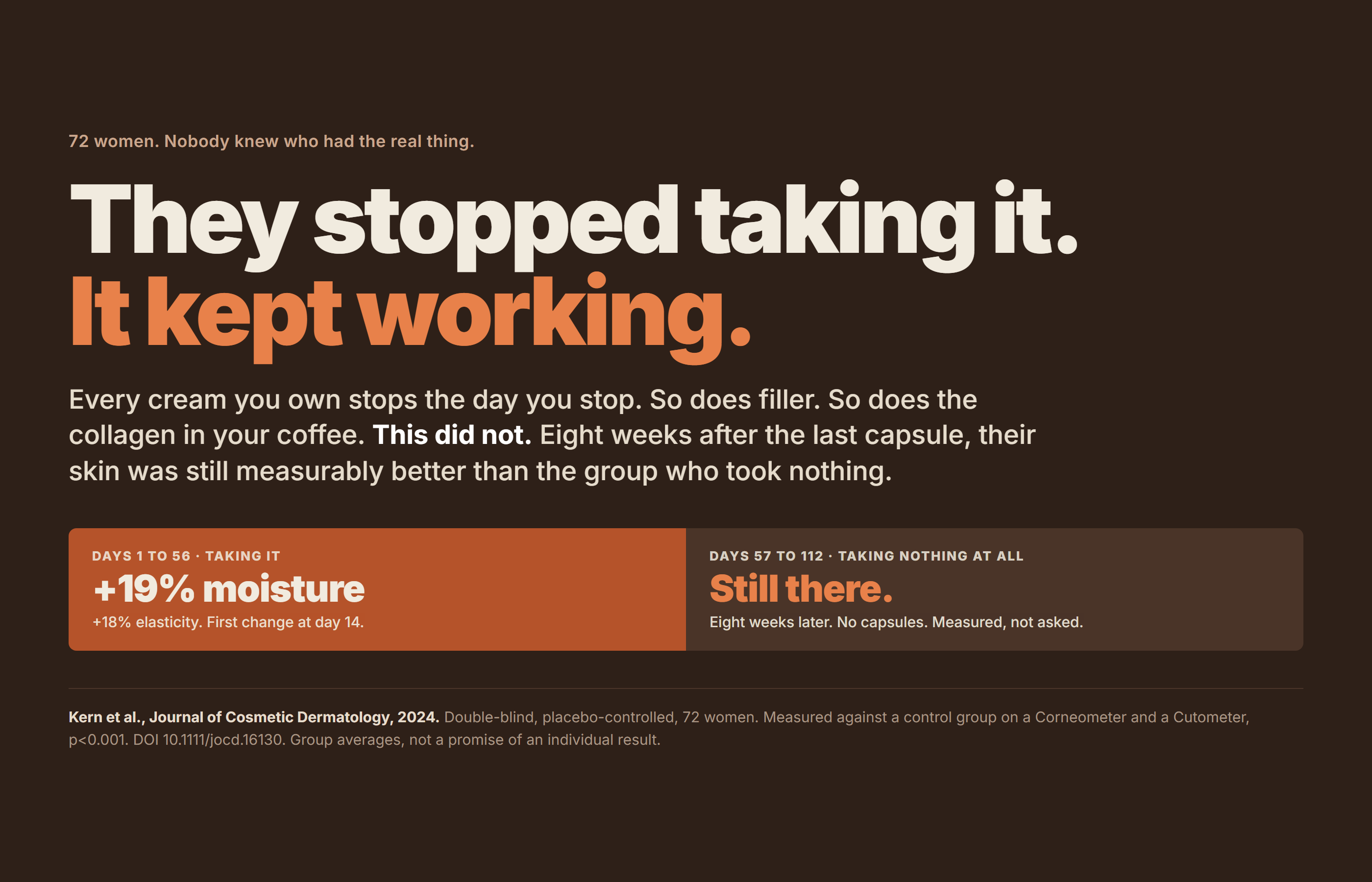
Kern et al., Journal of Cosmetic Dermatology 2024, 72 women, double-blind, placebo-controlled. 56 days of supplementation, then 56 days of follow-up with none. DOI 10.1111/jocd.16130.
Your serum works while it is on your face. Filler disappears on a schedule. Stop any of it and within days you are back where you started. You are renting the result.
In the Ceramosides trial they gave women the supplement for eight weeks. Then they took it away and kept measuring for another eight weeks.
Two months after the last capsule, their skin was still better than the women who never took it.
That is the difference between covering something up and actually rebuilding it. You cannot stop using a cream and keep the result, because the cream never changed anything.
Keep the SPF. Stop asking it to do the inside job.
Wear it tomorrow. It is the most proven surface tool you have. Just stop waiting for a seventh bottle to reach the other 80%, because it cannot, and no amount of money fixes a millimetre limit or a lab SPF you never apply.
Food already had the answer. We put the doses in one chocolate.
Your skincare cannot reach where aging happens. This can, because it uses the only door that layer has: your blood.
See SOOID Anti-Age
90 days. The trial’s first measured change was day 14, so you will know long before the window closes.
We do not have thousands of reviews. We have a placebo-controlled trial and a DOI.
Questions
Are you telling me to stop using sunscreen?
No. Wear it every day. It is still the best door bouncer you can buy. This page is about three facts the bottle will not print: you are not getting the lab number, it wears off, and it scores almost nothing against the inside damage that wrinkles you. Keep the cream. Add the inside job.
Is this instead of my routine?
No. Topical and oral ceramides are additive. When the barrier underneath is rebuilt, what you put on top has something to work with.
Why has my dermatologist not mentioned it?
Ceramosides is new and the key trial published in 2024. Dermatology is reasonably sceptical about ingestibles, because the category earned that. Take them the DOI. That is what it is for.
Is this collagen?
No. There is no collagen in it, deliberately. Collagen powder never solved why collagen breaks. This is the carotenoids and lipids that work on that break, plus vitamin A and biotin.
Contains: milk, wheat, soy, hazelnut, almond, macadamia. It is a real chocolate. Check before you order.
Food supplement. Not a substitute for a varied diet. Individual results vary.